Glasgow has found itself at the centre of renewed national attention following a turbulent weekend marked by football-related disorder, emergency incidents across the city, and growing political pressure over policing and public safety.
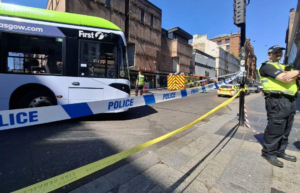
The largest flashpoint came after celebrations surrounding Celtic F.C.’s recent title-winning campaign, when significant unrest broke out in the Trongate area of the city centre. According to Police Scotland, 14 people were arrested in connection with disorder offences including rioting, assaulting officers, resisting arrest, and possession of offensive weapons. Two police officers suffered serious injuries during the violence, while several members of the public required hospital treatment.
Authorities said the disturbance escalated after emergency crews attempted to assist a man who had become unwell within a dense crowd of supporters. Officers reportedly came under sustained attack from bottles and other missiles as police attempted to disperse groups involved in violence. Senior police officials later criticised what they described as a recurring pattern of unmanaged celebrations in the city centre.
Assistant Chief Constable Mark Sutherland said a “small minority” had overshadowed the conduct of the wider crowd, adding that those involved should expect “robust action” from investigators. Police confirmed CCTV footage from both Parkhead and the Trongate area is now being examined as part of an ongoing inquiry.
The unrest has reignited debate inside Glasgow over how large football celebrations should be managed. Calls have intensified for dedicated fan zones, stricter crowd control measures, and greater cooperation between football authorities and local government. Some politicians and community leaders have also linked the violence to wider concerns about drug misuse and alcohol abuse in Scotland’s biggest city.
The latest incidents come as Glasgow continues to face mounting pressure on public infrastructure and emergency services. Earlier this week, major travel disruption affected parts of the city after a collision involving a lorry and a car near Junction 22 of the M8 caused severe delays across several motorway routes. Emergency crews closed lanes for hours during rush-hour traffic while one casualty was taken to hospital.
Separately, police also responded to an emergency incident on Rutherglen Bridge, forcing another closure on one of the city’s busiest connecting routes. Motorists were advised to avoid the area as officers carried out investigations.
Meanwhile, Glasgow City Council has come under criticism after nearly 1,000 motorists were wrongly issued bus-lane penalties due to what officials admitted was a camera enforcement error linked to ongoing roadworks near Cathedral Street. The council later apologised and confirmed refunds would be issued to affected drivers.
The city is also preparing for fresh transport disruption next month after officials confirmed that almost 30 streets across central Glasgow will temporarily close to accommodate large-scale film productions. While organisers have not revealed which movies are being shot, speculation is growing that several major international productions are returning to the city, which has increasingly become a popular stand-in location for American and European urban settings.
At the same time, Glasgow’s cultural and sporting profile remains strong despite recent tensions. The city hosted the 2026 Scottish Cup Final at Hampden Park this weekend, where Celtic F.C. defeated Dunfermline Athletic F.C. 3–1 to complete a domestic double. Tens of thousands of supporters descended on the city for the match, further increasing pressure on policing and transport systems already stretched by recent incidents.
Despite the challenges, city leaders insist Glasgow remains resilient and capable of balancing its growing international profile with ongoing regeneration projects. Recent developments such as the opening of Riverside Park on the historic Govan waterfront have been promoted as symbols of the city’s transformation from industrial powerhouse to modern cultural destination.
However, with public safety, transport disruption, and crowd management now dominating headlines, pressure is mounting on both local authorities and national agencies to reassure residents that Scotland’s largest city can manage the demands of major events without descending into repeated disorder.